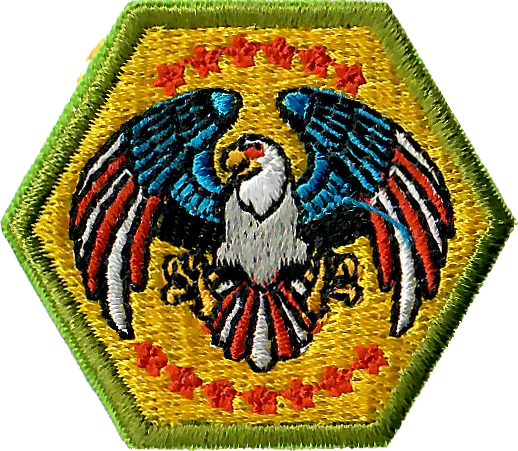
The Military Service & Veterans Badge invites
Scouts to explore the values, history, and human stories behind
military service. Designed to deepen understanding and foster respect,
this badge connects Scouts with the heritage of our Armed Forces and
the individuals who have served our nation with courage and
commitment.
Through hands-on learning, meaningful conversations, and active
community involvement, Scouts develop a richer appreciation for
service, leadership, peace, and patriotism.
Test Lab Badge Patch
For most achivements and events in Scouting, patches are created to commemorate the accomplishment. Looking back on the patches you have earned is a great way to remember your Scouting experiences. Also, patches are a major trading item among Scouts.
Scouting America does not create or sell patches for the Test Lab badges during their pilot phase. However, an unofficial patch has been created by Scoutmaster Bucky. This patch can only be worn on the back of the merit badge sash as the front is reserved for official merit badges.
Current Scouts BSA requirements as of September 3, 2026
This Test Lab offering is valid until October 1, 2026.
1.
Explore Military Heritage. Do the following:
a.
Learn about Robert Baden-Powell’s military service. Discuss with
your counselor what he learned about people, values, and culture
through his military service and how it influenced the founding of
Scouting.
Select a historical military conflict. Discuss with your counselor
what caused it and how leadership, planning, or values affected its
outcome, how it was resolved, and discuss what lessons can be learned
from it.
Understand the Cost of War and the Value of Peace. Do the following:
a.
Discuss with your counselor why military conflict should be a last resort.
b.
Do ONE of the following:
a.
Read or listen to President Dwight D. Eisenhower’s “Atoms for
Peace” speech and explain the objectives and role of the
International Atomic Energy Agency (IAEA) in promoting peaceful
uses of nuclear energy.
United States Armed Forces. Do ONE of the following:
a.
Choose one of the branches of service of the United States and
research its history, its mission, and its organization. Explain to
your counselor what you learned.
Learn about the Veterans History Project organized by the Library
of Congress. Conduct and record an interview of a veteran using those
guidelines. Share your recording with your counselor and the veteran.
With the veteran’s permission, share it with the Library of
Congress.
Explain how rank and insignia show respect, order, and
responsibility within the military.
6.
Reflect on Symbols of Service. Do the following:
a.
Discuss with an active-duty member, reservist, or veteran what
their uniform and the American Flag mean to them as a military member.
Share what you learned with your counselor. Describe what proper
respect for the flag means to them.
b.
Discuss with your counselor what your uniform and troop flag mean
to you.
7.
Honor Veterans. Do the following:
a.
Participate in a Veterans Day, Memorial Day, or other event that
honors veterans in your community, school, or place of worship.
Discuss with your counselor what role you played and what you
learned from the experience.
c.
Visit a veterans’ organization, military museum, memorial, or
cemetery. Discuss with your counselor what you learned about service,
sacrifice, and remembrance.
8.
Military Academies. Do the following:
a.
Learn about the purpose and history of TWO of the U.S. military
academies: the U.S. Military Academy at West Point, the U.S. Naval
Academy, the U.S. Air Force Academy, the U.S. Coast Guard
Academy, and the U.S. Merchant Marine Academy.
Careers. Explore careers related to this military
service. Research one career to learn about the training and education
needed, costs, job prospects, salary, job duties, and career
advancement. Your research methods may include — with your parent or
guardian’s permission — an internet or library search, an interview with
a professional in the field, or a visit to a location where people in
this career work. Discuss with your counselor both your findings and
what about this profession might make it an interesting career.