Dancing is a fun and exciting way to express yourself, stay active, and connect
with others. Every style of dance—from hip hop and ballet to cultural and
partner dances—has its own rhythm, history, and story to tell. In the Dance
Test Lab Badge, you’ll learn how to move safely, warm up properly, and
understand what makes every dance unique. You’ll explore different styles of
dance, learn about famous dancers, and even perform your own routine. Whether
you’re new to dancing or already love it, this badge will help you build
confidence, creativity, and coordination while having a great time moving to
the beat.
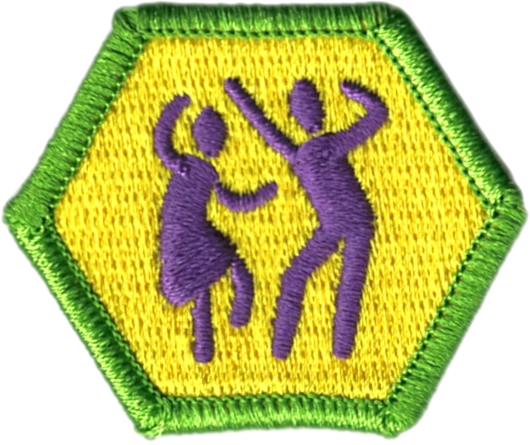
Test Lab Badge Patch
For most achivements and events in Scouting, patches are created to commemorate the accomplishment. Looking back on the patches you have earned is a great way to remember your Scouting experiences. Also, patches are a major trading item among Scouts.
Scouting America does not create or sell patches for the Test Lab badges during their pilot phase. However, an unofficial patch has been created by Scoutmaster Bucky. This patch can only be worn on the back of the merit badge sash as the front is reserved for official merit badges.
Current Scouts BSA requirements
as of April 4, 2026
This Test Lab offering is valid until November 1, 2026.
1.
Preventing Injury. Do the following:
a.
Explain to your counselor how you can prevent injuries while
participating in dancing activities and what you should do to
anticipate, help prevent, mitigate, and respond to these hazards.
Explain what you need to take into consideration before trying
potentially dangerous moves including but not limited to jumps,
flips, and lifts.
Explain to your counselor how to appropriately warm-up prior to
dancing activities to protect joints and prevent injury.
Demonstrate three dance warm-ups.
Show that you know first aid for injuries that could occur while
dancing, including cuts, scratches, abrasions, concussions,
blisters, sprains, stress fractures, tendonitis, and back injuries.
Styles of Dance. Name and briefly describe SIX types or
styles of dancing from the following list, noting if this is a dance that
may be performed alone, if the dance generally requires a partner or
group, or if it could be either a solo or partner dance.
Research. Research TWO of the types of dance you learned
about in requirement 3 by doing the following for EACH type of dance you
chose:
a.
Give a brief history, including its origin, how it came to be in
the United States if it originated elsewhere, and where in the
world/country it is most often performed.
b.
Name/describe different variations of this style of dancing, if
any.
c.
Name some specific types of dance steps/moves particular to this
type of dance. Does this dance tell a story through movement? If
so, please describe.
d.
Include information on at least one person who became well-known
performing, teaching, or choreographing this type of dance.
e.
Note if anyone with a physical disability (such a person with
hearing or sight impairment or a person who uses a wheelchair)
could participate in this type of dancing. What accommodations
would that person need to participate?
f.
Locate and share a place near you/in your state where you could
watch or participate in this type of dance as a part of a
performance, competition, or class. Find out when and where this is
offered and what the cost would be to watch or participate.
g.
Watch a performance of this type of dance and discuss with your
counselor. (While viewing an in-person performance is preferable, a
recorded performance may also be permitted.)
Learn a dance. Use at least THREE types of warm-ups prior to your
routine to prepare different muscle groups for the exercise. The
dance may be solo, group, or partner dance and can use a memorized
choreographed routine or an improvised dance. It should be a
minimum of 2 minutes long or several shorter dances that add up to
at least 2 minutes. The dance should demonstrate at least three
different dance moves/steps and should contain music with
Scout-appropriate lyrics, if applicable.
b.
Perform the dance for your counselor or submit a video of your
performance to your counselor. Describe to your counselor what
precautions you took to avoid injury before and during your
performance. Name or describe the 3 different dance moves that you
learned, the 3 different warm-ups you chose, and the 5 Elements of
Dance in your routine.
6.
Careers. Do ONE of the following:
a.
Explore careers related to Dance. Research one career to learn
about the training and education needed, costs, job prospects,
salary, job duties, and career advancement. Your research methods
may include — with your parent or guardian’s permission — an
internet or library search, an interview with a professional in the
field, or a visit to a location where people in this career work.
Discuss with your counselor both your findings and what about this
profession might make it an interesting career.
Explore how you could use knowledge and skills from dance to pursue
a hobby. Research any training needed, expenses, and organizations
that promote or support it. Discuss with your counselor what
short-term and long-term goals you might have if you pursued this.